library(plant)Extrinsic drivers
guide
Environmental conditions and recruitment can change while a patch develops. plant represents these outside inputs as extrinsic drivers: named functions that return a value for any simulation time.
Use a constant driver when conditions remain fixed. Use a variable driver when they change, supplying time (x) and value (y) control points from which plant constructs a smooth interpolation:
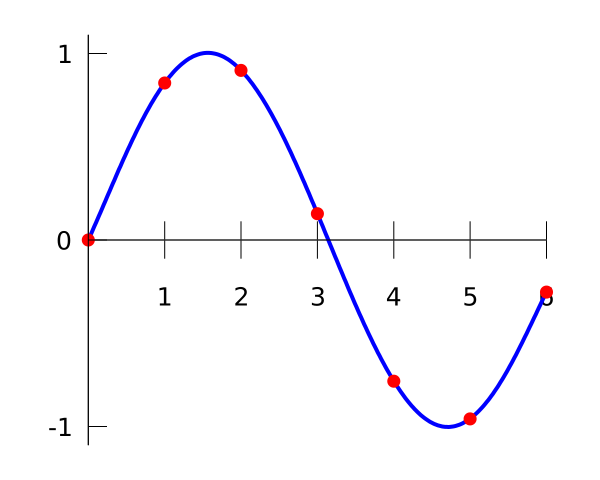
Every driver—such as "rainfall", "ca", or "birth_rate"—uses this same constant-or-spline interface. By default, a spline cannot be evaluated outside the time range supplied by its control points. Make sure those points cover the whole simulation unless you deliberately enable extrapolation.
Rainfall
In TF24, rainfall supplies water to the soil balance and therefore affects the leaf-level water economy and growth. A new TF24 environment provides a constant rainfall driver with value 1:
env <- Environment("TF24")Replace it with a different constant when rainfall is fixed:
env <- Environment("TF24")
env$extrinsic_drivers_set_constant("rainfall", 3.14)
For changing rainfall, supply paired time and rainfall values. Between these control points, the driver is interpolated smoothly:
x_pts <- seq(0, 200, 1)
rain <- list(
  x = x_pts,
  y = 1 + sin(x_pts)
)
env <- Environment("TF24")
env$extrinsic_drivers_set_variable("rainfall", rain$x, rain$y)
The resulting driver can be evaluated at any time inside the supplied range. The time 5.634 was not one of the control points, so this value comes from the interpolation:
env$extrinsic_drivers_evaluate("rainfall", 5.634)[1] 0.3977089We can also evaluate the function at a vector of times and get a numeric vector of rainfall values:
env$extrinsic_drivers_evaluate_range("rainfall", c(5, 1.2, 78.345))[1] 0.04107573 1.93048445 1.19379529The full climate driver set
Rainfall is only one of the climate drivers used by TF24 and TF24f. You do not need to change all of them; use this table to find the input relevant to your scenario.
| Driver | Meaning | TF24 default |
|---|---|---|
PPFD |
Photosynthetic photon flux density, i.e. light (\(\mu\)mol m\(^{-2}\) s\(^{-1}\)) | 1800 |
rainfall |
Rainfall, driving the soil-water balance | 1 |
atm_vpd |
Atmospheric vapour-pressure deficit (kPa) | 1 |
ca |
Atmospheric CO\(_2\) partial pressure (Pa — so the default 40 is \(\approx\) 400 ppm) |
40 |
leaf_temp |
Leaf temperature (\(^\circ\)C) | 25 |
atm_o2_kpa |
Atmospheric O\(_2\) partial pressure (kPa) | 21 |
atm_kpa |
Atmospheric pressure (kPa) | 100.5 |
birth_rate uses the same driver machinery but is set separately for each species rather than on the environment.
Each of these is configured exactly the same way as rainfall above: a constant with extrinsic_drivers_set_constant(), or a time-varying spline with extrinsic_drivers_set_variable(). For example, to hold CO2 fixed at a different concentration than the TF24 default:
env <- Environment("TF24")
env$extrinsic_drivers_set_constant("ca", 60)
To vary it through time, pass x and y control points just as for rainfall:
x_pts <- seq(0, 200, 1)
ca_ramp <- list(
  x = x_pts,
  y = 40 + 0.2 * x_pts   # a rising atmospheric CO2 trajectory
)
env <- Environment("TF24")
env$extrinsic_drivers_set_variable("ca", ca_ramp$x, ca_ramp$y)
env$extrinsic_drivers_evaluate("ca", 100)
Because every driver shares this same constant-or-spline mechanism, the same recipe covers any climate-forced scenario: a steadily rising ca spline for a CO2 ramp, a rainfall spline that dips and stays low for a drought pulse, or a leaf_temp spline for a warming trajectory. For instance, a drought pulse superimposed on an otherwise steady rainfall regime might look like:
x_pts <- seq(0, 200, 1)
drought_y <- ifelse(x_pts >= 80 & x_pts <= 120, 0.1, 1)
env <- Environment("TF24")
env$extrinsic_drivers_set_variable("rainfall", x_pts, drought_y)
Only the TF24 and TF24f strategies read these atmospheric and leaf drivers (atm_vpd, ca, leaf_temp, atm_o2_kpa, atm_kpa) and couple them into the leaf-level water economy described in Assimilation & hydraulics. FF16 and K93 instead use their canopy light profile; they do not read these TF24 climate drivers. All strategies can receive the separate, per-species birth_rate driver described below.
Birth rates
A species’ birth rate describes the seed rain entering each patch. In the size-structured PDE, it is the boundary condition that introduces new plants.
Pass birth rates to add_strategies(). Each species needs one entry: either a constant number or a list of x and y control points.
p0 <- scm_base_parameters("TF24")
p0$max_patch_lifetime <- 25      # short patch keeps the hydraulic solve fast

# two species
lmas <- trait_matrix(c(0.0825, 0.125), "lma")

x_pts <- seq(0, 200)
birth_rates <- list(
    species1 = list(x = x_pts, y = 1 + sin(x_pts)),
    species2 = 3.14
  )

p1 <- add_strategies(p0, lmas, TF24_hyperpar,
          keep_existing = FALSE,
          birth_rate = birth_rates)

# Customise the default TF24 soil column and rainfall trajectory for this run.
env <- Environment("TF24")
env$set_soil_number_of_depths(15)
env$set_soil_water_state(rep(0.2, 15))
rain_t <- seq(0, p0$max_patch_lifetime, length.out = 1000)
env$extrinsic_drivers_set_variable("rainfall", rain_t, 0.25 * sin(2 * pi * rain_t) + 1.0)

ctrl <- Control()
out <- run_scm(p1, env, ctrl)
Inspecting the driver at a particular time is a useful check that the species received the intended recruitment schedule:
out$patch$species[[1]]$extrinsic_drivers$evaluate("birth_rate", 7)[1] 1.656987